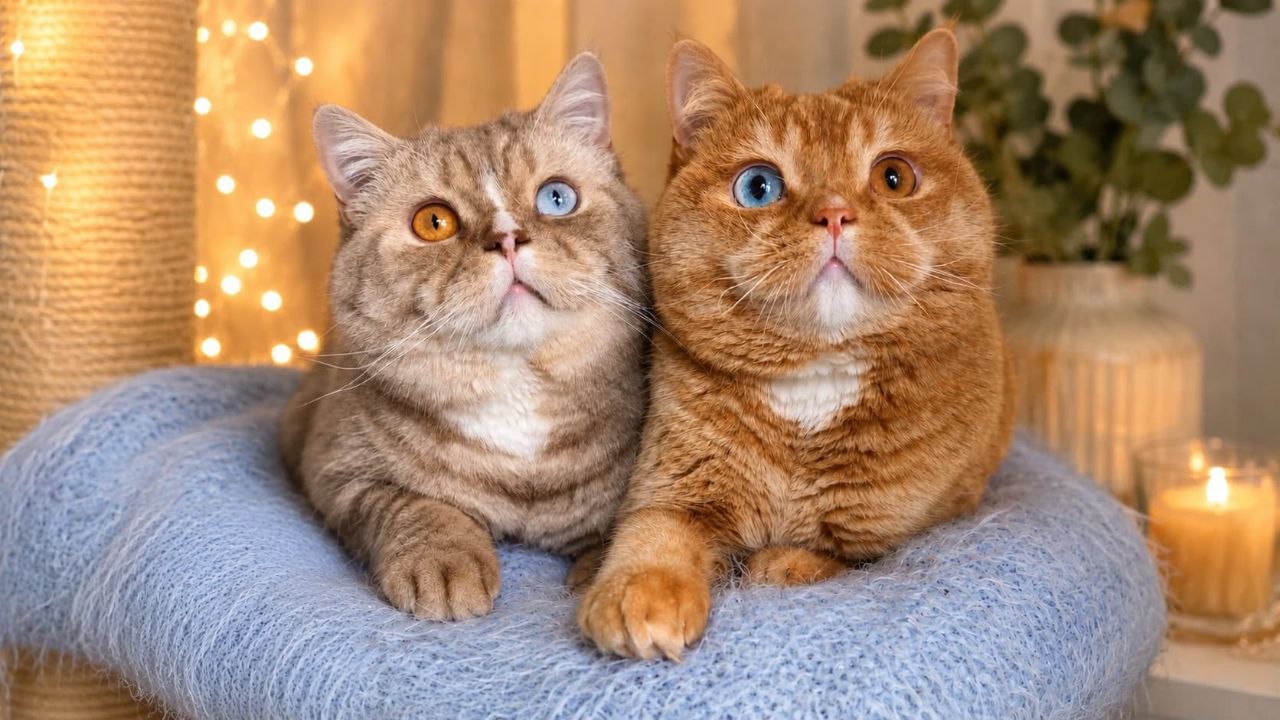
Few coat patterns are as widely recognized or beloved as the classic combination of slate grey and crisp white. However, when observing a domestic shorthair white and grey beside an authentic, pedigreed British Shorthair Blue and White Bicolor (EMS code BRI a 03), an untrained observer might initially see only superficial color similarities. In reality, these two felines represent completely distinct worlds of felinology, genetics, skeletal architecture, and health predictability.
While a random-bred white and grey shorthair cat possesses unique charm, robust vitality, and historical importance as a working domestic companion, the pedigreed British Shorthair Bicolor is the product of over a century of meticulous preservation breeding governed by strict morphological standards under organizations such as the Fédération Internationale Féline (FIFe Standard #729) and the World Cat Federation (WCF). Understanding the deep genetic, anatomical, and behavioral distinctions between a common domestic feline and a certified purebred British Shorthair allows prospective guardians to make informed decisions that match their lifestyle, expectations, and commitment to feline welfare.
Genetic Architecture of White and Grey Bicolor Coat Patterns
The appearance of grey and white fur on any feline is governed by specific genetic loci, but the uniformity, depth, and symmetry of the expression differ drastically between domestic cats and show-standard pedigree British Shorthairs.
The Dilute Locus (D) and Black Eumelanin (B)
- The Foundation of Slate Grey: What the public colloquially describes as "grey" is genetically known in pedigree felinology as blue. Blue is the dilute form of black eumelanin, governed by the recessive mutation (d) at the Dense/Dilution (D) locus. To express a true blue coat, a cat must inherit two recessive dilution alleles (d/d) combined with at least one dominant black allele (B/-).
- Pigment Distribution in Purebreds vs. Domestics: In a pedigreed British Shorthair, generations of selective breeding ensure that the blue pigmentation is sound, uniform from base to tip, and free from ghost tabby striping or silver tipping. In a typical domestic shorthair white and grey, the grey coloration often conceals underlying agouti tabby genes (A/-), resulting in visible bands, ghost rings on the tail, or brownish oxidation (rusting) caused by unregulated pigment density.
The Piebald White Spotting Gene (S Locus)
- *Variable Penetrance of the White Spotting Allele (S): The white areas on both domestic and purebred cats are dictated by the dominant white spotting allele (S*), which impairs melanoblast migration from the neural crest during embryonic development.
- Random Domestic Distribution vs. Strict Pedigree Bicolor Standards: In a random-bred white and grey shorthair cat, the white spotting gene expresses unpredictably. The cat may have asymmetrical facial patches, mismatched white socks, an irregular white locket, or scattered belly blotches. Conversely, under FIFe Standard #729 for a British Bicolor (BRI a 03):
1. The colored (blue) areas must occupy between one-half and two-thirds of the total body surface, leaving the remaining areas pure, sparkling white. 2. The facial mask should ideally feature an inverted white "V" extending symmetrically between the eyes to the muzzle. 3. The chest, neck, belly, and all four feet must be solid white, creating an immaculate contrast against a solid blue mantle and blue tail.
Skeletal Conformation and Cranial Morphology Comparison
The most profound differences between a domestic shorthair and a British Shorthair lie beneath the coat in skeletal conformation, bone density, and facial structure.
Cobby Architecture vs. Semi-Foreign Athleticism
- The British Shorthair Cobby Conformation: The purebred British Shorthair is defined by a massive, compact, low-slung torso (cobby build). The chest is broad and deep, the shoulders and rump are powerfully muscled, and the backline is short and level. Adult males weigh between 5.5 kg and 8 kg, supported by short, thick, heavily boned legs ending in massive, rounded paws.
- The Domestic Shorthair Athletic Conformation: A domestic shorthair typically exhibits a moderate, semi-foreign, or mesomorphic body type. Their limbs are slender to medium-boned, the torso is longer and more cylindrical, and overall weight averages between 3.5 kg and 5.5 kg. Their anatomy is honed for agility, jumping, and predatory speed rather than heavy muscular solidity.
Cranial Contours and Facial Features
The head silhouettes of the two cats are immediately distinguishable when viewed face-on or in profile:
| Anatomical Feature | Pedigreed British Shorthair Blue & White (BRI a 03) | Domestic Shorthair White & Grey (Random-Bred) |
|---|---|---|
| Skull Shape | Massive, round, spherical from all angles; wide breadth between ears | Modified wedge or oval; narrower skull base with flatter forehead |
| Cheeks and Jowls | Full, prominent stud jowls; deeply padded whisker cushions forming a permanent "smile" | Flat to moderately rounded cheeks; well-defined muzzle with prominent pinch |
| Nose Structure | Short, broad, straight nose with a gentle indentation/dip; no sharp Persian break | Medium to long straight nose without defined stop or concavity |
| Ear Conformation | Small to medium ears, rounded at the tips, set widely apart on the skull curve | Medium to large upright, pointed ears set high and close together |
| Eye Shape and Color | Large, fully round, widely spaced; deep, brilliant copper or glowing orange | Almond to oval shape; typically hazel, green, yellow, or pale amber |
| Coat Structure | Dense, plush double coat (crisp texture); thick woolly undercoat standing away from body | Single coat or light undercoat; flat-lying, sleek, smooth guard hairs |
| Tail Anatomy | Thick, heavy at the base, short to medium length, ending in a blunt, rounded tip | Slender, tapering progressively to a fine, pointed tip |
Coat Texture: The Iconic Plush "Crisp" Double Coat
A hallmark of the British Shorthair that is virtually never found in a domestic shorthair white and grey is the unique tactile feel of its double coat.
The British Shorthair coat features an undercoat of equal length to the primary guard hairs. This creates a dense, plush pile that stands crisply away from the body like velvet. When stroked against the grain, it snaps back with resilient elasticity—a trait felinologists refer to as crispness. Because the coat is dense and multi-layered, it provides thermal insulation against cool, damp weather.
In contrast, the coat of a domestic shorthair is predominantly a single-layered or lightly undercoated pelage. It lies flat against the body contours, feels sleek and silky to the touch, and sheds in single guard hairs rather than dense downy tufts. While the domestic coat requires minimal grooming, the British Shorthair double coat demands regular combing with a metal greyhound comb to remove dead undercoat during seasonal shedding cycles.
Temperament and Behavioral Dynamics
Generations of selective breeding have established highly distinct behavioral temperaments in pedigree British Shorthairs:
The Calm, Dignified Aristocrat
The British Shorthair is universally celebrated for its placid, even-tempered disposition. Known as the "gentle giant" of the cat world, they display low reactivity, quiet vocalizations, and an exceptional tolerance for household routines. They are steadfastly affectionate companions who prefer staying near their human family on the floor or sofa rather than climbing doorframes or demanding constant lap-sitting. Their grounded nature makes them exceptionally compatible with well-mannered children and calm dogs.
The Dynamic Instincts of the Domestic Shorthair
A white and grey shorthair cat from non-pedigree origins typically inherits a broader spectrum of survival behaviors. They often possess higher energy levels, stronger vertical climbing instincts, and intense predatory prey drives inherited from working barn-cat ancestors. While wonderfully loving and playful, their behavior can range from hyper-independent to intensely vocal depending on individual genetics and early pediatric socialization.
Health Diagnostics: Random Hybrid Vigor vs. Certified Pedigree Screening
One of the most persistent myths in the pet community is that non-pedigree domestic cats are universally healthier than purebred cats due to "hybrid vigor." While genetic diversity provides broad protection against certain homozygous recessive conditions, random-bred cats remain fully vulnerable to infectious diseases, trauma, and unmonitored hereditary disorders.
Predictability Through Comprehensive Genetic Testing
In an authentic preservation breeding program like Grand Liberty, operated under strict German Animal Welfare licensing (§11 TierSchG):
- Polycystic Kidney Disease (PKD1): An autosomal dominant genetic defect that causes fatal renal cysts in cats. Every Grand Liberty breeding queen and stud is certified PKD1 N/N via Laboklin DNA sequencing, ensuring zero transmission to offspring. Random domestic cats carry unknown PKD1 carrier risk if ancestral pedigree crosses occurred.
- Hypertrophic Cardiomyopathy (HCM): An inherited cardiovascular disease involving left ventricular wall thickening. Our breeding adults undergo annual Doppler echocardiograms by certified feline cardiologists. In domestic cats, HCM frequently goes undetected until sudden thromboembolism or heart failure occurs.
- Blood Group Incompatibility: Up to 30–50% of British Shorthairs possess Type B blood. Mating a Type B female with a Type A male causes lethal Neonatal Isoerythrolysis (NI) in nursing kittens. Certified catteries genetically type every breeding pairing to eliminate this fatal risk.
Buyer and Adopter Verification Checklist
Whether you are deciding to adopt a shelter domestic shorthair white and grey or purchase a certified purebred British Blue & White kitten, use this checklist to guide your journey:
- [ ] Define Your Expectations Clearly: If you seek an active, agile, unique rescue companion with variable looks, adopt a domestic shorthair from a licensed animal welfare shelter.
- [ ] Demand Registered Pedigree Documentation for Purebreds: If purchasing a British Shorthair Blue & White, require an official 5-generation pedigree from FIFe (Standard #729), WCF, or TICA.
- [ ] Verify Parent DNA Certificates: For purebred British kittens, inspect verified Laboklin laboratory certificates confirming both parents are PKD1 N/N clear.
- [ ] Review Cardiologist HCM Echocardiograms: Confirm that both parents have recent clear Doppler heart scans performed by a recognized feline cardiologist.
- [ ] Evaluate Physical Conformation: Look for the cobby build, heavy bone structure, spherical head, small rounded ears, and crisp plush double coat that characterize the true British breed.
- [ ] Inspect Veterinary Passport and Microchip: Ensure the kitten has received an ISO 11784/11785 microchip, complete FVRCP immunizations, and certified deworming.
- [ ] Confirm Minimum Handover Age: Ethical breeders never separate kittens from their mothers prior to 12 to 14 weeks of age.
Both the domestic shorthair and the British Shorthair Blue and White Bicolor bring deep joy and companionship to feline-loving homes. By understanding the genuine genetic, anatomical, and health distinctions between them, you can celebrate each cat for what it truly is—whether a lively, unique domestic rescue or an aristocratic masterpiece of purebred felinological preservation.