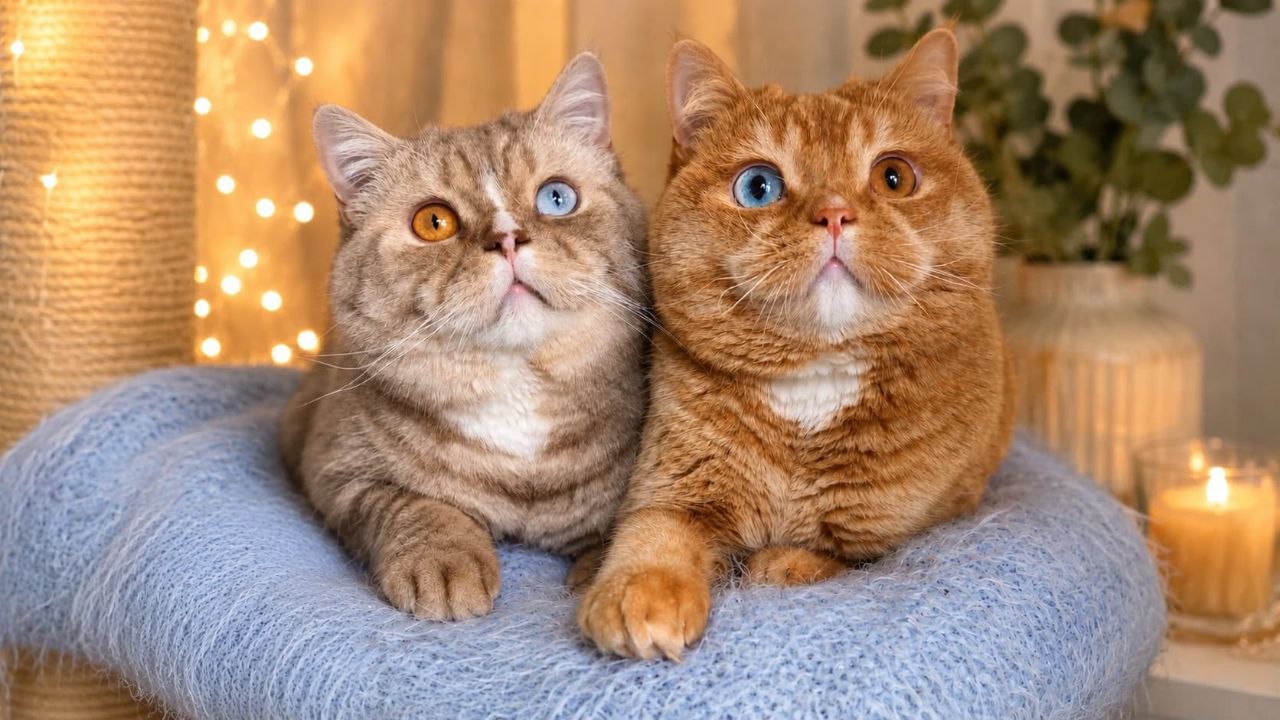
The british shorthair lynx point represents one of the most mesmerizing and genetically sophisticated color varieties in modern feline preservation breeding. Combining the robust, cobby silhouette of the classic British Shorthair with the striking colorpoint restriction of the Siamese and the intricate wild barring of the agouti tabby, this variety displays crisp tabby markings on the facial mask, ears, legs, and tail, set against a pale, luminous body and accompanied by vivid, deep ice-blue eyes. Often described as a "tabby point" across European registries, the lynx point captivates enthusiasts who admire both wild feline markings and aristocratic British elegance.
Breeding an authentic lynx point british shorthair requires an advanced understanding of coat genetics, temperature-sensitive enzyme dynamics, and strict conformation standards under the Fédération Internationale Féline (FIFe Standard #729). Because the colorpoint phenotype is governed by an autosomal recessive allele ($c^s$) that restricts pigment synthesis to the cooler extremities of the body, breeders must carefully balance pattern contrast, eye pigment saturation, and coat density without sacrificing the massive bone structure and round head characteristic of the breed. At Grand Liberty, operating under Section 11 of the German Animal Welfare Act (§11 TierSchG), all pointed breeding lines undergo certified Laboklin genetic profiling and annual Doppler echocardiograms to ensure superior health alongside physical perfection. In this guide, we explore the genetic architecture of the lynx point, trace its coat development from birth to maturity, compare primary color variations, and outline essential care protocols.
The Genetic Architecture of the Lynx Point British Shorthair
To understand how a british shorthair lynx point develops its unique appearance, one must examine the interaction between the Himalayan colorpoint gene, the agouti gene, and polygenic modifiers governing contrast.
The Himalayan Colorpoint Gene ($c^s$) and Tyrosinase Sensitivity
The colorpoint pattern is caused by the recessive $c^s$ allele at the Color locus ($C$). A lynx point must inherit two copies of this allele ($c^s c^s$), one from each parent:
- Thermo-Sensitive Enzyme Action: The $c^s$ mutation produces a heat-sensitive form of tyrosinase, the rate-limiting enzyme in melanin synthesis. At normal core body temperatures (approximately 38.5°C or 101.3°F), tyrosinase is unstable and ceases melanin production, causing the torso to remain pale cream, ivory, or white.
- Extremity Pigmentation: At cooler peripheral body zones—the facial mask, ears, distal limbs, and tail—tyrosinase remains active, allowing dense melanin synthesis. This results in the characteristic "points" that define the colorpoint family.
The Agouti Gene ($A$) and Tabby Barring
What distinguishes a lynx point from a solid point (such as a seal point or blue point) is the presence of the dominant Agouti gene ($A-$):
- Unmasking Tabby Markings: In solid colorpoint cats ($a/a$), the non-agouti mutation suppresses the underlying tabby pattern, resulting in solid dark points. In contrast, the presence of the dominant agouti allele ($A$) allows the ancestral tabby pattern to manifest exclusively on the colored points.
- Facial Mask Characteristics: A high-quality lynx point displays a sharply defined "M" marking on the forehead, delicate "mascara lines" radiating from the outer eye corners, spotted whisker pads, and pale ear thumbprints (wildmark).
- Barred Extremities: The legs exhibit distinct horizontal tabby bracelets, and the tail is ringed with dark bands terminating in a solid dark tip.
The Mystery of Ice-Blue Eyes in Lynx Points
One of the most defining characteristics of the lynx point british shorthair is its piercing, luminous ice-blue eye color. While traditional British Shorthairs (such as blues, blacks, and bicolors) possess rich copper, orange, or amber irises, pointed felines always exhibit blue eyes:
Optical Mechanics of Feline Blue Irises
1. Suppression of Stromal Melanin: The same $c^s c^s$ genotype that inhibits melanin synthesis in the warm torso also prevents melanocytes from depositing pigment granules in the anterior stroma of the iris. 2. Rayleigh Scattering: Because the iris stroma lacks melanin, incident light enters the clear ocular media and is scattered by microscopic structural fibers. Shorter blue wavelengths scatter back out toward the observer, creating an intense optical blue hue similar to the physics of the sky. 3. Evaluating Blue Hue Saturation: Under FIFe standards, judges evaluate pointed British Shorthairs on the depth and purity of their blue eye color. Preservation breeders select for deep, vivid sapphire and cobalt tones, penalizing pale, washed-out, or greenish-blue irises.
Coat Evolution: From Pure White Newborns to Adult Shading
Prospective owners choosing a british shorthair lynx point must understand that pointed kittens undergo a dramatic color transformation during their first two years of life.
The Ontogenetic Color Timeline
- At Birth (0 to 10 Days): Because the feline womb maintains a uniform, warm temperature of 38.5°C, tyrosinase remains completely inactive during gestation. All lynx point kittens are born completely pure white, with pink nose leather and paw pads.
- First Pigment Appearance (2 to 4 Weeks): As newborns adapt to the cooler ambient nursery environment, extremities cool down. The earliest faint grey or tan smudges emerge on the ear tips, nose leather margin, and tail tip.
- Pattern Definition (6 to 12 Weeks): The agouti barring becomes visible. The distinctive facial "M," eye contour rings, and leg bracelets crystallize into view. Eye color stabilizes from early neonatal cloudy blue into clear ice blue.
- Torso Maturation and Ghost Shading (6 to 24 Months): As the cat matures, the pale body coat gradually develops subtle shading that harmonizes with the point color. In colder climates or during winter months, the body coat darkens slightly due to lower ambient temperatures, while remaining distinctly paler than the extremities.
Primary Color Varieties of Lynx Point British Shorthairs
Under FIFe and European registration systems, lynx points are categorized using the Easy Mind System (EMS) code `BRI x 21 33`, where `x` represents the base color, `21` indicates unspecified tabby pattern on points, and `33` signifies the pointed restriction:
| Color Variety | EMS Code | Point Color & Markings | Body Ground Tone | Eye Color | Nose Leather & Paw Pads |
|---|---|---|---|---|---|
| Seal Lynx Point | BRI n 21 33 | Deep seal brown/black tabby bars on warm cream ground | Pale beige to warm fawn; subtle tonal shading | Vivid deep ice blue | Brick red outlined in black; dark brown/black pads |
| Blue Lynx Point | BRI a 21 33 | Slate-blue/grey tabby bars on light silver-grey ground | Cool glacial white to glacial ivory | Pure piercing sapphire blue | Slate grey or brick red outlined in blue; blue pads |
| Chocolate Lynx Point | BRI b 21 33 | Warm milk chocolate tabby bars on ivory ground | Pure ivory white; minimal body shading | Brilliant luminous blue | Cinnamon/milk chocolate pink; chocolate pads |
| Lilac Lynx Point | BRI c 21 33 | Frosty pink-grey tabby bars on magnolia white ground | Shimmering cool magnolia white | Soft, clear sky blue | Lavender-pink; pinkish-grey pads |
| Golden Lynx Point | BRI ny 21 33 | Black tabby bars on intense warm apricot-golden points | Pale ivory to warm peach | Deep crystal blue | Brick red with dark rim; dark brown pads |
FIFe Conformation Standards for Lynx Point British Shorthairs
While the pointed coat and blue eyes are inherited from colorpoint ancestry, the conformation of a lynx point british shorthair must never resemble the slender, tubular Siamese body type. Under FIFe Standard #729, conformation remains paramount:
- Body Structure: Cobby, low-slung, powerful, with broad chest, strong shoulders, and short, sturdy legs terminating in round, firm paws.
- Head Architecture: Massive round skull with full cheeks, broad well-developed muzzle, gentle nose break without a sharp stop, and small, rounded ears set wide apart.
- Coat Texture: Short, dense, and crisp (crisp double coat with abundant undercoat). It must "crack" slightly when the cat moves, never lying flat or feeling long and silky like foreign pointed breeds.
- Contrast Evaluation: The points must be sharply defined against the pale body. While subtle body shading is accepted in mature cats, heavy mottling or complete loss of contrast is penalized in show evaluations.
Care, Grooming, and Nutrition for Lynx Points
Maintaining the pristine condition and contrast of a british shorthair lynx point involves targeted environmental and nutritional practices:
- Ambient Temperature Regulation: Because tyrosinase is temperature-sensitive, keeping your indoor home between 20°C and 23°C (68°F–73°F) prevents excessive cold-induced darkening of the body coat.
- Grooming Regimen: Brush the double coat twice weekly with a stainless steel greyhound comb to eliminate loose undercoat fibers. This ensures healthy air circulation to the skin and prevents mats without stripping guard hairs.
- Dietary Tyrosine & Phenylalanine Balance: High-quality animal proteins rich in balanced amino acids support crisp melanin definition in the points without causing reddish tarnishing (rusting) in blue or lilac varieties.
- Cardiorenal Health Screening: Lynx points require the same rigorous health protections as all British Shorthairs. Ensure both parents possess verified Laboklin PKD1 N/N genetic certificates and recent cardiologist-performed Doppler echocardiograms ruling out HCM.
Selection Checklist for Lynx Point Kittens
When evaluating a prospective lynx point kitten, review this targeted checklist:
- [ ] Point-to-Body Contrast: Verify clear differentiation between point markings and the lighter body coat.
- [ ] Facial Pattern Symmetry: Check for the well-defined agouti "M" on the forehead and distinct eye-contour lines.
- [ ] Unbroken Eye Clarity: Confirm eyes are vivid blue, clear, and free from strabismus (squinting) or nystagmus, which can occasionally occur in unvetted pointed lines.
- [ ] True Cobby Architecture: Ensure the kitten displays a sturdy, compact body, thick tail with rounded tip, and strong bone structure rather than a slender frame.
- [ ] Parental Health Clearances: Demand official Laboklin DNA certificates confirming PKD1 N/N status and annual cardiologist Doppler HCM clearances for both parents.
- [ ] Authentic Registry Pedigree: Insist on an official 5-generation pedigree from FIFe, WCF, or TICA recording all ancestors and color codes.