Introducing a British Shorthair kitten to a resident dog requires a structured, multi-phase protocol spanning two to four weeks. British Shorthairs exhibit a grounded, low-reactivity demeanor, but their stocky physiology and kitten vulnerability make them susceptible to predatory chase triggers. Successful cohabitation hinges on absolute initial separation, systematic scent swapping, visual exposure through solid barriers, controlled leashed face-to-face sessions reinforced with high-value rewards, elevated vertical resting zones inaccessible to canines, and strictly partitioned meal locations to prevent resource guarding.
How to Introduce Kitten to Dog Successfully
A structured introduction relies on systematic desensitization and counter-conditioning rather than uncontrolled face-to-face meetings. The process begins before any visual contact occurs by establishing a dedicated sanctuary room for your British Shorthair kitten, furnished with food, water, scratching posts, and a covered litter box. This setup prevents sensory overload while the kitten decompresses from travel and learns the ambient acoustics of the household.
Gradual progression is guided entirely by body language rather than an arbitrary calendar. Once the kitten explores its sanctuary with an upright tail and the dog shows no agitated pacing outside the door, transition to visual contact through a securely mounted baby gate or cracked door secured with a door strap. The canine must remain on a loose leash under handler control. Reinforce calm, disengaged behavior from the dog using low-arousal verbal praise and small pea-sized treats. The goal is to condition both animals to view the presence of the other as a predictor of calm stability and pleasant rewards.
Physical cohabitation must occur only after repeated, uneventful barrier sessions where the dog willingly breaks gaze to focus on commands and the kitten shows relaxed curiosity. Initial off-leash interactions should remain brief (under five minutes), occurring in a neutral room where the kitten has unobstructed access to high ground and the dog is tired from prior physical and mental exercise.
- Phase 1: Zero visual contact, auditory and environmental habituation (Days 1 to 4).
- Phase 2: Tactile scent transfer and reciprocal territory exploration without visual contact (Days 4 to 8).
- Phase 3: Visual access through double baby gates with leash control and high-value counter-conditioning (Days 8 to 14).
- Phase 4: Supervised room-sharing with loose-leash control on the dog and clear vertical retreats for the kitten (Day 15 onward).
Scent Swapping Protocol Between Cats and Dogs
Cats and dogs experience the world primarily through olfaction. Scent swapping bypasses visual predatory reflexes by acclimating each animal to the other's chemical signature before visual cues can trigger excitement or defensive posturing. British Shorthairs release calming facial pheromones from their temporal and perioral glands; harvesting these scents helps project security into the dog's personal space.
To execute the protocol, rub a soft clean hand towel or microfiber cloth gently along the British Shorthair kitten's cheeks, chin, and base of the tail. In parallel, rub a separate towel down the dog's spine and chest. Place the cat-scented towel near the dog's resting bed—initially a few feet away, gradually moving it closer as long as the dog demonstrates indifferent or calm olfactory investigation without pawing or whining.
Simultaneously, present the dog-scented towel to your British Shorthair kitten, paired immediately with a high-value treat such as freeze-dried poultry or a dab of wet food. If the kitten sniffs the cloth calmly or rubs against it, reward the interaction. Once both animals ignore or display relaxed affiliative responses to the cloths, progress to room swapping: let the dog sniff the kitten's sanctuary room while the kitten explores the dog's living area in safety.
Vertical Safe Zones for Cats Away from Dogs
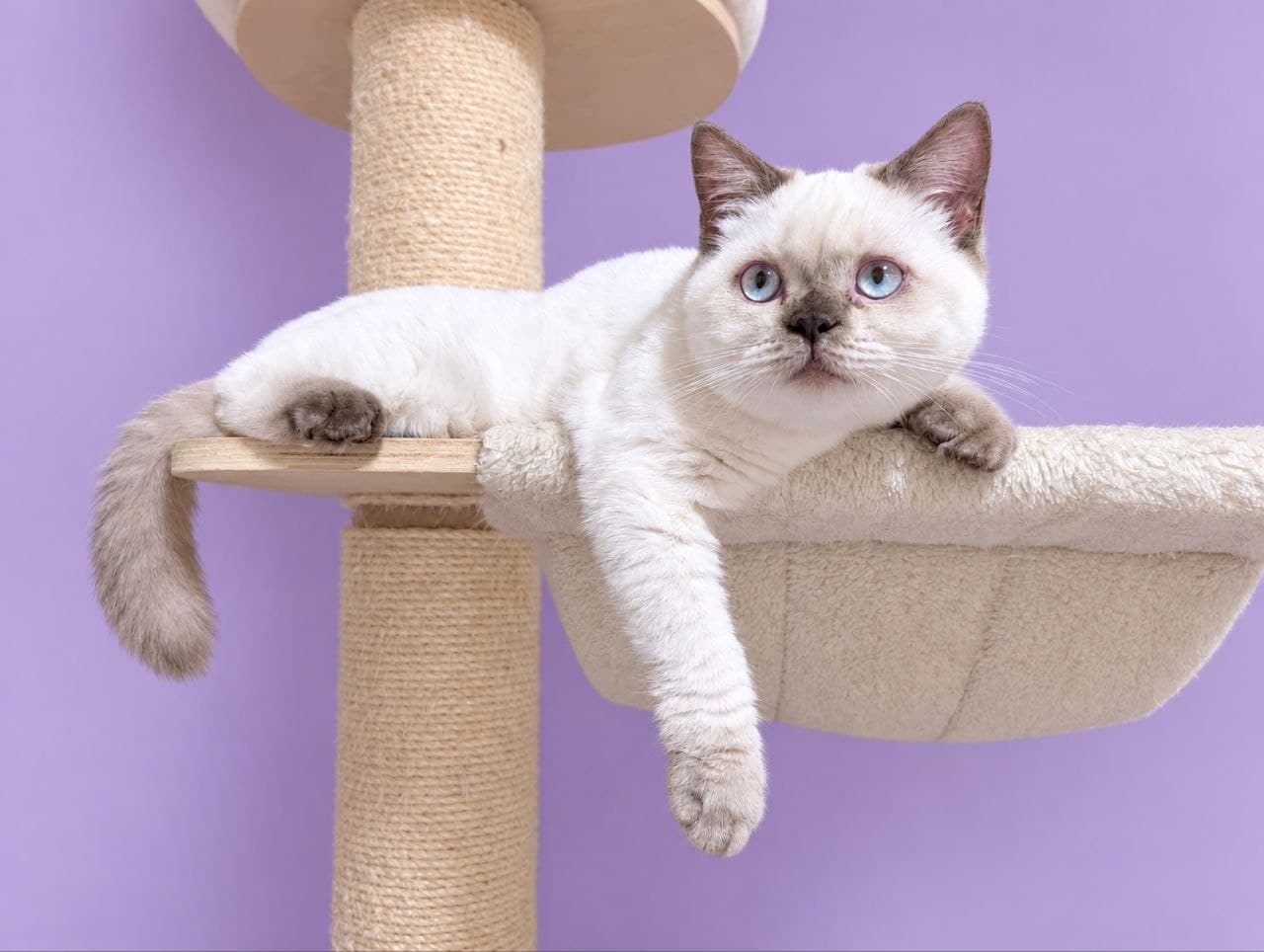
British Shorthairs are broad-chested, robust felines that prefer observing their environment from moderate elevations rather than precarious, towering heights. Establishing vertical safe zones provides your kitten with critical psychological autonomy, allowing it to survey canine movement without feeling trapped at ground level.
Vertical pathways should offer seamless entry and exit trajectories. A trapped cat is a defensive cat; dead-end shelves or isolated perches that a dog can corner are dangerous. Install wide-plank wall steps, heavy-based multi-tier cat trees with minimum 15-centimeter diameter scratching posts, and bridge pathways that link to secure bookshelves or mantle ledges. Ensure jumping distances match the kitten's developing growth plates by maintaining stepping increments of no more than 30 to 40 centimeters.
In addition to aerial structures, ground-level safe havens must remain fortified. Use pet gates with built-in cat doors calibrated exclusively to the kitten's dimensions, or install door stops that hold interior doors open precisely 10 centimeters. This guarantees the kitten can slip away into dog-free zones instantly if startled by an energetic canine approach.
Preventing Food Guarding Between Dogs and Cats
Resource guarding is a leading cause of interspecies household conflict. High-protein feline food formulations are intensely appetizing to canines, often inducing competitive, rapid ingestion or territorial defense in dogs. Conversely, a British Shorthair kitten interrupted while feeding can develop lifelong avoidance patterns or stress-induced cystitis.
Spatial segregation during feeding must remain an absolute rule. The kitten should receive meals exclusively on elevated surfaces (such as a designated feeding shelf or sturdy counter) or behind closed doors in its sanctuary space. Never leave wet food or dry kibble bowls accessible at ground level in shared corridors.
Similarly, canine feeding stations must remain off-limits to the kitten. Even an exceptionally docile dog may deliver a punitive snap if a curious kitten approaches its food bowl while eating. Establish a rigid feeding routine: crate the dog or place it in a separate room during meal times, collect all residual food bowls within twenty minutes, and store canine chew bones safely out of reach when the animals share communal living zones.
Common Mistakes When Introducing Cats to Dogs
The most damaging error during cohabitation introductions is forcing physical closeness. Restraining a British Shorthair kitten in your arms while presenting it to a dog strips the cat of its fight-or-flight choices, almost invariably resulting in panic scratches, severe stress, and defensive hostility toward the dog. Both animals must retain autonomous movement within safety boundaries.
Another critical mistake is misinterpreting canine predatory drive as harmless enthusiasm. Intense visual fixation, stiff posture, trembling excitement, or unblinking stares indicate predatory focus rather than friendly curiosity. Allowing a dog to fixate or chase a fleeing kitten—even playfully—reinforces predatory motor patterns that are exceedingly difficult to extinguish once established.
Finally, caregivers frequently neglect litter box privacy. Dogs are naturally inclined toward coprophagy, and canine interference at the litter box creates severe elimination anxiety for kittens. Place litter boxes in dog-excluded zones secured with magnetic microchip doors or cat-sized latches to maintain total hygiene and psychological security for your British Shorthair.
Dog-to-Kitten Transition Readiness Milestones
- Scent Neutrality: The dog sniffs kitten-scented cloth with soft posture and walks away without fixation.
- Reliable Disengagement: Handler can divert the dog's visual attention away from the kitten barrier using a basic verbal cue.
- Kitten Confidence: The British Shorthair shows relaxed locomotion, normal grooming, and tail-up posture within visual line of sight.
- Passive Barrier Calm: Both pets can consume meals on opposite sides of a baby gate simultaneously without agitation.
- Secure Infrastructure: Minimum of two independent vertical escape routes and one dog-free sanctuary zone fully operational.
- Supervised Leash Fluency: Zero lunging, whining, or predatory stalking during 10-minute supervised living room sessions.
Summary & Next Steps
Introducing a British Shorthair kitten to a dog is a methodical journey that prioritizes predictability, spatial control, and sensory acclimation. By allowing scent familiarity to precede sight, reinforcing non-reactive canine behaviors, and anchoring the home with elevated escape zones and separated feeding spaces, you establish a harmonious multispecies foundation. Next, audit your home layout to map out vertical highways and select sturdy, non-tip cat furniture tailored to the robust build of the British Shorthair.
Sources & References
- American Association of Feline Practitioners (AAFP) and ISFM Feline Environmental Needs Guidelines (Journal of Feline Medicine and Surgery)
- Overall, K. L. - Manual of Clinical Behavioral Medicine for Dogs and Cats (Elsevier Health Sciences)
- DePorter, T. L. et al. - Evaluation of Interspecies Interactions and Feline Social Behavior in Multispecies Households
- World Small Animal Veterinary Association (WSAVA) - Guidelines for Animal Welfare and Interspecies Management